
A leading surfactant for treating RDS in newborns.
Infasurf delivers rapid relief through quick adsorption, ensures sustained improvement by lowering surface tension, and offers the advantage of single-dose success for enhanced lung compliance.
Why Infasurf
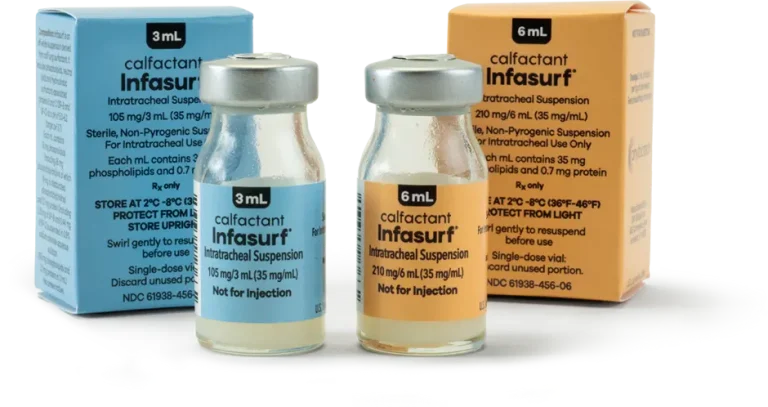
Rapid Relief

Infasurf quickly lowers surface tension, which promotes rapid respiratory recovery 1,5
- Infasurf’s SP-B content (0.74%), as a percentage of total phospholipids, helps reduce surface tension.7
- Quickly Lowering Surface Tension1,5:
- Helps prevent alveoli collapse
- Increases ability to achieve equal distribution in the lung
- Promotes rapid respiratory recovery by increasing lung compliance.
- Infasurf demonstrates surface tension lowering activity similar to native lung surfactant1
Disclaimer: Preclinical and biologic testing do not predict clinical effects. While clinical studies have demonstrated that SP-B is an essential element, they have not determined the minimum SP-B to phospholipid ratio required for optimal surfactant efficacy.
Sustained duration of action

Infasurf demonstrates a higher rate of FiO2 improvement compared to Survanta2
- Infasurf demonstrates a 38% higher rate of FiO2 reduction compared to Survanta in the first hour2
- Infasurf demonstrates a superior rapid onset of action and duration of action compared to Survanta2
- Infasurf significantly lowers FiO2 in the first hour, and throughout the next 24 hours.2
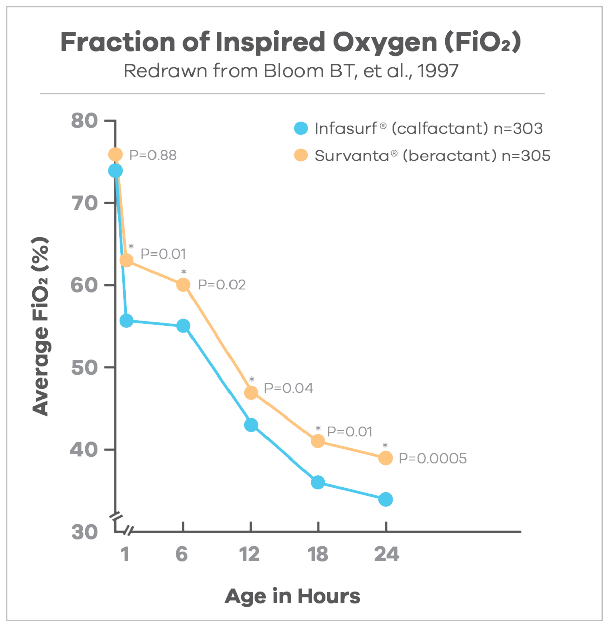
Redrawn from Bloom BT, et al., 1997
Disclaimer: Improvements in FiO2 requirements may not necessarily reduce dosing or predict long term outcomes.
Additional doses of Infasurf may be required.
Single Dose Success

Infasurf demonstrates high rates of single-dose success in two independent studies
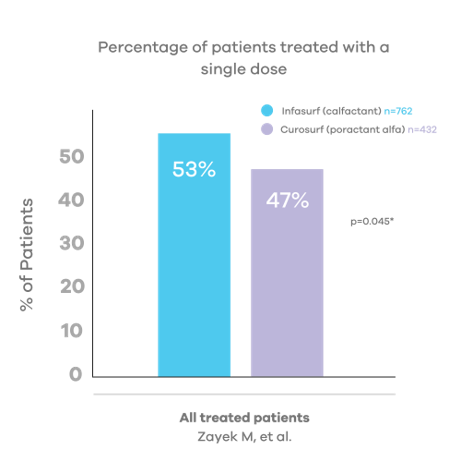
Zayek MM, et al. JPPT. 2018;23(2):146-151.
A retrospective study comparing the pharmacy costs of Infasurf and Curosurf at the University of South Alabama Children’s and Women’s Hospital from 2010-2016. Calfactant was administered to 762 patients over 50 months, an average of 15.2 per month; poractant alfa was administered to 432 patients over 22 months, an average of 19.6 per month.
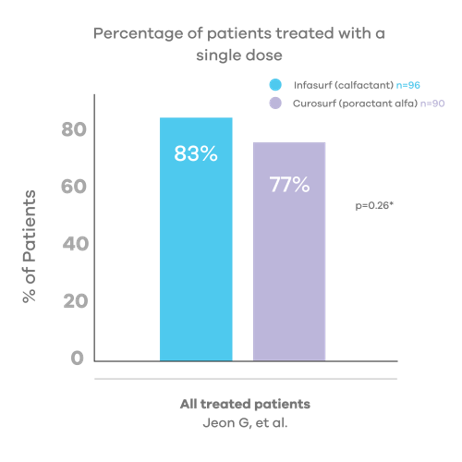
Graph redrawn from Jeon GW, et al. Yonsei Med J. 2015;56(2):433-439.
A retrospective study comparing the efficacy of Infasurf, surfactant-TA and Curosurf. A total of 332 preterm infants at 24‒31 weeks’ gestation with RDS were enrolled and allocated to three groups; Group 1 (n=146, surfactant-TA), Group 2 (n=96, calfactant), and Group 3 (n=90, poractant alfa).
There are no prospective, randomized clinical trials comparing Infasurf and Curosurf with respect to safety or efficacy.
*Proportion of single dose success, Infasurf v. Curosurf
Please see Important Safety Information. Refer to list of Re-Dose Rate Publications.
References:
- Notter RH, Wang Z, Egan EA, et.al. Component-specific surface and physiological activity in bovine-derived lung surfactants. Chem Phys Lipids. 2002;114:21-34.
- Bloom BT, Kattwinkel J, Hall RT, et al. Comparison of Infasurf (calf lung surfactant extract) to Survanta (beractant) in the treatment and prevention of Respiratory Distress Syndrome. Pediatrics. 1997;100:31-38. 23.
- Zayek MM, Eyal FG, Smith RC. Comparison of the pharmacoeconomics of calfactant and poractant alfa in surfactant replacement therapy. JPPT. 2018;23(2):146-151.
- Jeon GW, Oh M, Sin JB. Efficacy of surfactant-TA, calfactant and poractant alfa for preterm infants with Respiratory Distress Syndrome: A retrospective study. Yonsei Med J. 2015;56(2):433-439.
- Seeger W, Gruba C, Gunther A, et al. Surfactant inhibition by plasma proteins: differential sensitivity of various surfactant preparations. Eur Respir J. 1993;6:971-977.