Dosing & Administration

Dosing Instructions

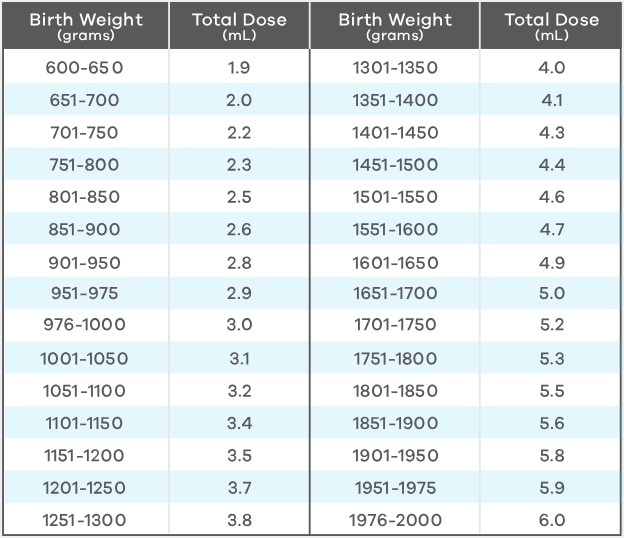
  • Each dose of Infasurf is 3 mL/kg body weight at birth.
  • Dosing frequency of Infasurf is every 12 hours for a total of up to 3 doses, if needed.
Infasurf Dosing Chart

Infasurf Preparation:

  1. Calculate total dose as 3 mL/kg body weight at birth.
    • Warming not required. For patient comfort, Infasurf® (calfactant) can be warmed to room temperature.
    • NEVER use radiant/artificial warming devices to warm Infasurf® (calfactant).
  2. Repeatedly invert the vial(s) to homogenize settled suspension – DO NOT SHAKE.
  3. Draw each aliquot through a 20-gauge needle into separate syringes with care taken to avoid excessive foaming*.
  4. Each syringe should contain an amount of air EQUAL to the liquid volume.
    • Unopened, unused vials of Infasurf® (calfactant) that have warmed to room temperature can be returned to refrigerated storage within 24 hours for future use.
    • Infasurf® (calfactant) should not be returned to the refrigerator more than once.

Infant Preparation:

  1. Position infant supine with the head midline.
    ET Tube MUST BE:

    • IN PROPER POSITION – confirm presence of expired CO2, bilateral chest rise and equal bilateral breath sounds.
    • UNOBSTRUCTED – suction as needed.
    • SECURELY FIXED IN PLACE – use extra care if only manual retention is used during instillation.
  2. INFANT MUST BE CLINICALLY STABLE – Confirm SpO2, Expired CO2, HR, and BP are at acceptable levels.

Instillation:

  1. Attach a syringe to instillation catheter.
  2. Advance catheter to the distal tip of ET Tube.
    • DO NOT advance catheter beyond the carina into either main stem bronchus.
    • During instillation, hold the plunger up and the outlet down – air must be above liquid during instillation.
  3. Instill surfactant suspension quickly and smoothly over 1-2 seconds followed immediately by the air. (Air will clear surfactant out of catheter.)
    • DO NOT pause between the liquid and air instillation.

Ventilation

  1. Withdraw instillation catheter rapidly and gently turn infant to left or right side to optimize surfactant distribution.  With newer neuroprotective protocols, can we state baby can be left midline?
  2. Initiate ventilation with a flow inflating bag or a T-piece resuscitation device (i.e. Neopuff™, Neo-Tee®, ventilator).
  3. Effective gas exchange will require the use of effective peak inspiratory pressure (PIP), inspiratory time (IT), inspiratory plateau pressures, and positive end-expiratory pressure (PEEP).

Continue ventilation for 1-2 minutes or until adequate ventilation is established.

Use:

  • Initial peak inspiratory pressure sufficient enough to overcome high inertia and flow resistance of liquid in the airway – this will propel surfactant to the distal lung.*
  • Initial inspiratory time sufficient to create a plateau pressure (proximal airway pressure is equilibrated throughout the lung).*
    • This promotes uniform ventilation and rapid surfactant distribution to the distal lung.
  • Maintain positive end-expiratory pressure.*

Infant Assessment

  1. Look for signs that instillation has been completed successfully: normal chest rise, color, expired CO2, SpO2, HR and BP.
  2. Listen for clear breath sounds – MINIMAL REFLUX AND ABSENCE OF RHONCHI ARE PHYSICAL SIGNS that surfactant is out of airways and absorbed by the alveoli.
  3. Adjust ventilatory support up or down as needed.
  4. Subsequent aliquots are given once cardiopulmonary stability is established.
  5. Never hesitate to suction the ET Tube and airway whenever airway obstruction is suspected. Suctioning is not contraindicated after surfactant instillation.

For full administration instructions, please see Full Prescribing Information.

Infasurf Storage:

  • Refrigerate INFASURF (calfactant) intratracheal suspension at 2°C to 8°C (36°F to 46°F) and protect from light.
  • Must store the 105 mg/3 mL (35 mg/mL) vial upright. Do not remove INFASURF from the refrigerator for more than 24 hours.
  • Unopened, unused INFASURF vials that have reached room temperature within 24 hours can be refrigerated for future use; however, do not re-refrigerate INFASURF more than once.
  • Record the date and time on the carton when INFASURF is removed from the refrigerator.